
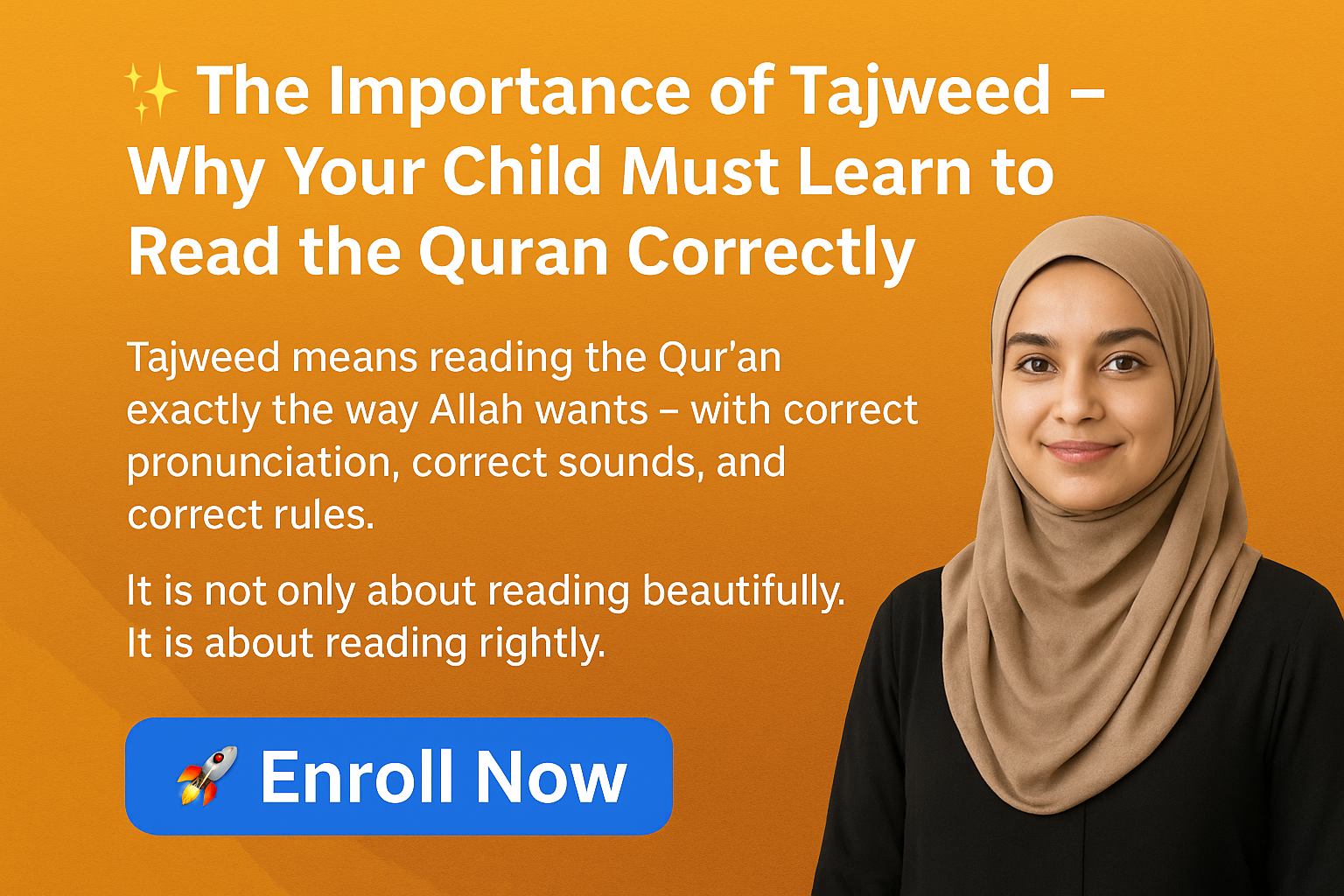
Learn Quran Online with Tajweed — Why Correct Recitation Protects Meaning
Every Muslim parent wants their child to love the Qur’an. We enroll them in schools, pay for tutors, and buy books — but sometimes the most important foundation is missed: Tajweed. Learn Quran Online with Tajweed is not just a course title — it is a promise to protect the words of Allah by teaching correct pronunciation, correct makharij (points of articulation), and correct application of rules so the meaning never changes.
What is Tajweed and why does it matter?
Tajweed literally means “to make better” — in recitation it refers to the rules that govern how each Arabic letter is pronounced, how long sounds are held, and how words join or separate. The Prophet ﷺ commanded care for the Qur’an: “الْقُرْآنَ خُذُوهُ» — take the Qur’an (teach it, learn it). More explicitly he said: “The best of you are those who learn the Qur’an and teach it.” (Sahih al-Bukhari).
Qur’anic Evidence: Recite with measured recitation
Allah says: وَرَتِّلِ الْقُرْآنَ تَرْتِيلًا — “And recite the Qur’an with measured recitation.” (Surah Al-Muzzammil, 73:4). This short command contains deep meaning: quality over speed, correctness over haste.
Small mistakes — big meaning change (clear examples)
The power of Tajweed is most clear when a small error changes meaning:
- قَلْب (Qalb) = heart — pronounced with a deep /q/ and correct vowel.
- كَلْب (Kalb) = dog — pronounced with /k/. If a child reads qalb as kalb, the meaning is completely wrong.
Another classic example is from Surah Ikhlas: قُلْ هُوَ اللّهُ أَحَد — “Say: He is Allah, the One.” If a student misreads the first word as كُلْ instead of قُلْ, the sentence becomes nonsensical or disrespectful. Tajweed prevents such errors.
How Tajweed differs from “just reading”
Many families focus on completing Juz’ or finishing the Qur’an in school, but speed without rules causes permanent mistakes. Learning Tajweed means:
- Knowing exact makharij (where each letter is produced).
- Understanding ikhfa, idgham, qalqalah, madd — the rules that guide length and merging.
- Reading slowly first, then with fluency while preserving meaning.
- Connecting recitation to tafsir so children hear the message, not just the sounds.
Why parents in UK/USA/Canada must prioritize Tajweed
Children in non-Muslim countries absorb many languages and sounds. If the Qur’an’s sounds are not taught precisely, wrong pronunciation becomes the norm. Correct Tajweed builds confidence, protects meaning, and strengthens identity. When your child recites correctly, they also gain the reward and respect that comes from honoring Allah’s word.
Practical problems schools miss
Regular school Quran classes may have large groups and little time for individual correction. Teachers try their best but can’t always correct every child’s makharij. That’s why one-to-one or small group online Tajweed lessons are so effective — focused correction, slow repetition, and recorded assignments allow real progress.
How I teach — method & guarantees
I am Misbah Saher, a female Quran teacher with over 5 years teaching experience. My approach for online Tajweed lessons includes:
- Beginner assessment (Noorani Qaida level check).
- Makharij drills — audio + visual demonstrations.
- Short daily assignments with recorded reading (parents can review).
- Small steps: one rule at a time until mastery.
- Translation & short tafsir to connect meaning and recitation.
- Soft, patient, child-friendly technique for ages 4+.
- Monthly progress reports and suggestions for parents.
What you will get when you enroll
- Free trial class for assessment (one session, no payment).
- Personalized study plan (what to learn weekly).
- Flexible timing — we match UK/USA/Canada timezones.
- Fee flexibility: “pay what you can” options and sibling discounts.
- Focus on both Tajweed rules and correct pronunciation.
Lesson structure (example)
Each lesson (30–45 minutes) includes:
- Warm-up: pronunciation of tricky letters (5 mins).
- New rule introduction (5–10 mins) with demonstration.
- Practice: reading phrases + teacher correction (10–15 mins).
- Assignment & recorded reading (5–10 mins).
Common parental concerns — answered
“My child won’t keep camera on.”
Camera optional. Progress is tracked by recorded submissions and weekly checks.
“I can’t pay full fee.”
We offer fee options — choose what works for you. The key is consistent learning, not high cost.
“My child already goes to school Quran class.”
Online Tajweed classes are complementary: focused correction for sounds that school class cannot always address.
Integrating Tajweed with Tafsir — teach meaning along with sound
Correct recitation is only complete when accompanied by understanding. For each surah we teach a short translation and an age-appropriate tafsir so children appreciate the words they recite — not only pronounce them.
Internal resources (use these pages on Steps2Jannah)
For more information, parents can visit these pages: About • Courses • Contact • Blog
Enrollment — WhatsApp auto-form (fast & simple)
Click any button below — WhatsApp will open with a pre-filled message. Fill the fields and send. I will receive your request instantly and reply to schedule the free trial.
📩 Contact on WhatsApp (Free Trial)
What parents notice after 4–8 weeks
Parents commonly report:
- Improved clarity in difficult letters (qaaf, gaaf, ayn, ha’)
- Sustained attention in recitation
- Confidence in reading aloud at home and in community
- Deeper appreciation of the Qur’anic meaning
A short dua for the student
Make this dua before lessons: “Rabbi zidni ilma” — “My Lord, increase me in knowledge.” May Allah bless every child who learns His Book.
References (Ayat & Hadith)
Qur’an: Surah Al-Muzzammil 73:4 — وَرَتِّلِ الْقُرْآنَ تَرْتِيلًا
Hadith: “The best of you are those who learn the Qur’an and teach it.” — (Sahih al-Bukhari)
Frequently asked questions (FAQ)
How old should my child be to start?
Children as young as 4 can begin Noorani Qaida and basic Tajweed drills. We adapt lessons to the child’s attention span.
Do you teach adults?
Yes — all ages welcome. Adult classes focus on fluency and deeper Tajweed rules.
What if my child is shy to speak on camera?
Camera is optional. Recorded assignments and one-on-one corrections ensure progress.
Final words — why act now
The Qur’an is a trust. Protecting its meaning is an act of love — for Allah and for your child’s future. Learn Quran Online with Tajweed is the first step: correct sound, preserved meaning, and a child who grows loving the Book of Allah.
Click “Enroll Now” and send the short WhatsApp form — I will reply within a few hours to schedule your free trial class, InshaAllah.